Institution · Abandoibarra
Guggenheim Museum Bilbao
The building that changed how a city imagines itself. Frank Gehry's museum of curving titanium opened in 1997 on a stretch of abandoned dockland, and it remains the single strongest reason many visitors come to Bilbao.
Architecture and approach
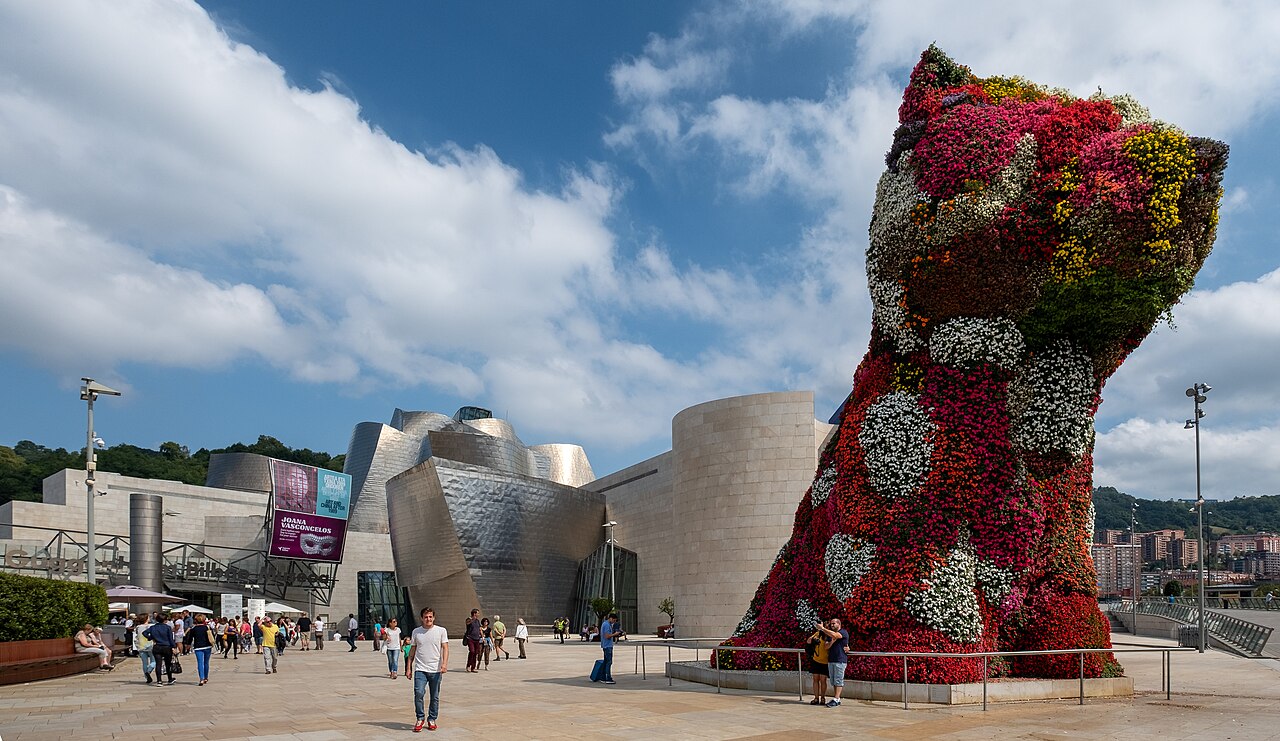
From the Abandoibarra promenade the museum reads as a cluster of petals, some clad in titanium, some in limestone, some in glass. The effect changes through the day as the light moves, which is why locals often suggest seeing it twice — once in the morning and once towards evening. The main entrance faces the city, with a second approach from the river side, and the plaza in front is itself a gallery of large sculpture.
The collections
Inside, the rooms are organised across three levels around a central atrium filled with light. The permanent holdings focus on art from the mid-twentieth century onward, and the museum is known for showing large, room-scale installations that make use of the unusual gallery shapes. Temporary exhibitions change through the year and often take up the whole of one floor, so a visitor should expect the balance between permanent and temporary material to shift.
What to expect from a visit
Allow two to three hours for the building and the main collections, and longer if a major exhibition is running. The museum is busy for most of the year; the calmest windows tend to be shortly after opening on weekdays and during the middle of the afternoon. Audio guides in several languages are offered at the desk, and the ground floor holds a shop, a café and cloakroom facilities.
Setting and surroundings
The museum sits at the centre of a district designed for walking. The Museum of Fine Arts is a short stroll inland, and the riverside path connects the building to the Zubizuri footbridge and the rest of the new city. For practical timing, see the opening rhythm page; for access details, see the accessibility guide.
A word on judgement
Not every visitor loves the crowds or the architecture, and that is a fair reaction. The museum is undeniably a spectacle, but beneath the spectacle are serious collections and serious curatorship. We describe it as both: a landmark and a working museum. Read it as one, and the visit is richer for it.